
Thursday, November 3, 2011
Silent Society of Hollywood Heritage Paying Tribute to Great Silent Film Actresses with an All-Day Silent Film Event

Tuesday, August 23, 2011
BEYOND THE ROCKS (1922) - Vintage Original 8x10 On-Set Still Photograph #19
Tuesday, July 12, 2011
The 16th Annual San Francisco Silent Film Festival

The 16th Annual San Francisco Silent Film Festival will be held on July 14-17, 2011 at the beautiful Castro Theatre in San Francisco. The festival opens with the silent film UPSTREAM, directed by John Ford and ends with HE WHO GETS SLAPPED, directed by Victor Sjostrom. This year's event features eighteen wonderful programs of new discoveries and restorations, with extraordinary live musical accompaniment by top musicians in the field, including the Alloy Orchestra, Stephen Horne, Dennis James, the Matti Bye Ensemble, the Mont Alto Motion Picture Orchestra, and Donald Sosin.
Of particular interest are two films by major directors: UPSTREAM (1927, US), director John Ford's splendid comedy which was thought lost for many years but was recently discovered in the vaults of the New Zealand Film Archive and preserved. Director F.W. Murnau's masterpiece
The festival continues with HUCKLEBERRY FINN (1927, US), directed by William Desmond Taylor; I WAS BORN, BUT... (1932, Japan); THE GREAT WHITE SILENCE (1924, UK); IL FUOCO (1915, Italy), directed by Giovanni Pastrone; THE BLIZZARD (1923, Sweden), directed by Mauritz Stiller; THE GOOSE WOMAN (1925, US), directed by Clarence Brown and starring Louise Dresser and Jack Pickford; THE WOMAN MEN YEARN FOR (1929, Germany), starring Marlene Dietrich in her first leading role; SHOES (1916, US), directed by Lois Weber; THE NAIL IN THE BOOT (1931, USSR), directed by Mikhail Kalatozov; and HE WHO GETS SLAPPED (1924, US), directed by Victor Sjostrom and starring Lon Chaney.
This year's festival also includes interesting panel discussions including AMAZING TALES FROM THE ARCHIVES: THE ARCHIVIST AS DETECTIVE, hosted by Jan-Christopher Horak of the UCLA Film and Television Archive and Melissa Levesque of the Academy Film Archive; a selection of WALT DISNEY'S LAUGH-O-GRAMS, hosted by Disney author and historian J.B. Kaufman; VARIATIONS ON A THEME: MUSICIANS ON THE CRAFT OF COMPOSING FOR SILENT FILM, featuring all of the musicians performing at this year's festival and hosted by composer/musician/performer Jill Tracy; and AMAZING TALES FROM THE ARCHIVES: KEVIN BROWNLOW ON 50 YEARS OF RESTORATION, featuring Academy Award Recipient and one of the world's foremost authority on silent film, Mr. Kevin Brownlow.
For more information on this year's exciting event, please visit the San Francisco Silent Film Society's website at www.silentfilm.org.
Monday, May 16, 2011
Rudolph Valentino Birthday Tribute

On the evening of Wednesday, May 11, 2011 a celebration in commemoration of the birthday of silent film legend Rudolph Valentino was held at the Hollywood Heritage Museum in Hollywood, CA. The Museum was filled to capacity as silent film enthusiasts came to hear noted author and Valentino historian Donna Hill gave an entertaining presentation in connection to her book, "Rudolph Valentino, the Silent Idol: His Life in Photographs".
Ms. Hill delighted the audience by showcasing various rare photographs of Valentino which were not able to be included in her book. We enjoyed seeing some never-before-seen candid photos of the handsome silent star as well as beautiful scene stills and on-set publicity stills from his many films. Ms. Hill's presentation was augmented by a condensed presentation of "Blood and Sand" as well as several contemporary and older newsreels and documentaries on Rudolph Valentino.
The event was complimented by a truly amazing display of just a portion of noted Valentino collector (and author of "Valentino the Unforgotten"), Tracy Ryan Terhune. We were treated to view in person original movie posters from "Blood and Sand," "The Young Rajah," "The Eagle," " The Conquering Power" as well as a superb selection of original lobby cards from these films as well as some rare "pre-star" titles. Even more impressive was Mr. Terhune's beautifully arranged display of ultra-rare personal items that belonged to Valentino (including a pair of binoculars with the original case, a silk top hat and various decorative silver pieces) as well as equally rare trophies from a dance contest, an original poster from Valentino's famed "Mineralava" dance tour with his wife, Natacha Rambova, and numerous other amazing pieces.
Hollywood Heritage Board member Mary Mallory produced the event which was initially introduced by Hollywood Heritage's President, Richard Adkins. This was a very special and enjoyable evening that played to a sell-out crowd and is yet another sign of the enduring popularity of the silent cinema and one of it's greatest stars... Rudolph Valentino.
Thursday, April 21, 2011
D.W. Griffith's Artistic Impact on the Film Making Industry

Movie director, Peter Bogdanovich gives a strong argument for the acknowledgment of D.W. Griffith's film making techniques and unsurpassed artistic impact on movie making and succeeding directors on his blog "Blogdanovich".
We fully agree and are showcasing his blog below to share his insightful posting with our audience. Bravo, Mr. Bogdanovich.
The Birth of a Nation
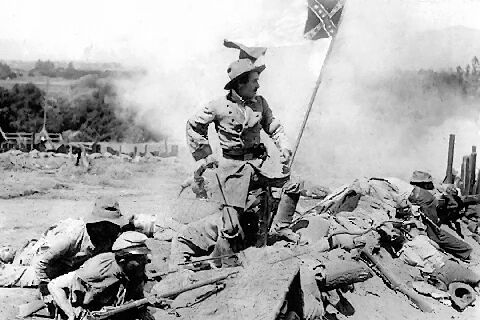
In January, 2000, the National Society of Film Critics issued a blistering statement of protest that “deplores the rash decision” made by the Directors Guild of America’s National Board a month before to retire the name of its highest (lifetime achievement) honor, the D.W. Griffith Memorial Award, citing as their reason the racist stigma attached to Griffith’s 1915 Civil War landmark, The Birth of A Nation (available on DVD), the second half of which depicts sympathetically the rise of the Ku Klux Klan. The Film Critics went on: “The recasting of this honor, which had been awarded appropriately in D.W. Griffith’s name since 1953, is a depressing example of ‘political correctness’ as an erasure, and rewriting, of American film history, causing a grave disservice to the reputation of a pioneering American filmmaker…The DGA’s national board might spend its time on more significant business: as a watchdog pressuring the industry to improve on its shameful record of employment of minority filmmakers.” In other words, the racist aspects for which Griffith’s name was being removed perhaps still prevailed in current industry hiring practices.
And, of course, not only American film history was being rewritten, but American history itself. Certainly it was not the fault of The Birth of A Nationthat it took another nearly fifty years for the civil rights movement to start making big differences. Griffith was being used as scapegoat not only for an industry but for the country as well. Remember, in 1915, the First World War having just begun, women—-black or white—-still didn’t have the right to vote. Do we no longer revere Washington or Jefferson because they kept slaves? In his brilliant documentary on the black heavyweight Jack Johnson of the 1910s, Unforgivable Blackness, Ken Burns quotes lengthy, virulently racist passages from such contemporary newspapers as The New York Times, Los Angeles Times and The Chicago Tribune. As Robert Graves has pointed out, it is impossible not to be a part of your times, even if you are against them.
When The Birth of A Nation opened—-an independent film, the world’s first $2.00 screen attraction, the first three-hour epic and, in terms of attendance, the most successful movie ever made—-it was immediately greeted with a storm of controversy, considered by some white liberal and black groups as “a flagrant incitement to racial antagonism,” authorities being urged in several states to ban its exhibition.
Griffith was deeply shaken by the accusations of prejudice. Being a Kentucky Southerner, born only a decade after the end of the Civil War, he had learned his slanted history from members of his own family, reduced to poverty by conditions during the Reconstruction, acknowledged by all historians as an extremely turbulent and tragic era for the South. As an answer to the outcry against The Birth of A Nation, Griffith put all the money he had earned into his next picture, a $2.5 million colossus (an unheard of cost for its time), Intolerance (1916), charting the course of prejudice through four ages of history from Babylonian times to the present. Though certainly very influential to filmmakers, Intolerance was not a success, and while Griffith still would have several more box-office hits, he actually never recovered his own financial equilibrium.
Despite every valid attack on the biased history presented by The Birth of A Nation, there also can be no denying the unsurpassed artistic impact it had on virtually all subsequent pictures. It was the first film ever screened at the White House; after seeing it President Wilson said, “It is like writing history with lightning.” Nevertheless, D.W. Griffith’s career neither began nor ended with this one notorious movie. In the seven years preceding, he made over 450 short films, which formed not only the essential alphabet, vocabulary and grammar of moviemaking, but were acknowledged as state of the art before there was an art; introducing a new, more intimate, acting style, bringing numerous stars to pictures, from Mary Pickford and Lillian Gish to Mae Marsh and Richard Barthelmess.
Of the almost thirty features he made after The Birth of A Nation, there are several humanist masterworks such as Hearts of the World, Broken Blossoms(an interracial love story), True Heart Susie, Way Down East, and Orphans of the Storm. When I asked the great filmmaking pioneer Allan Dwan how he had learned to direct, he said he went to see Griffith’s movies and just tried to do what Griffith did. Nearly everyone did that. John Ford is unthinkable without Griffith, of course, but so is Hitchcock. Orson Welles told a Spanish critic who was starting a film magazine that the most appropriate name for a definitive publication on cinema would be Griffith, and that’s what it became.
Since movie directing really begins with D.W. Griffith, the choice of his name for a director’s lifetime achievement award was not only apt but inevitable. The removal of his name, though addressing belatedly both a personal and a national sin, diminishes the artistic heritage of the prize. To see The Birth of A Nation today—-much of which remains remarkably affecting, like the battle sequences, the murder of Lincoln, the homecoming of the Southern colonel—-is all the better to witness afresh the terrible divisions that ravaged the country in the worst war of its history—-at a toll of 600,000 deaths—-the aftermath of which plagues us still. We can see as well how far we had to go, how far we have come, and how much farther we have yet to travel.
Peter Bogdanovich posted to Picture of the Week at 6:42 pm on April 20, 2011 | Permalink | Comments (1)
Thursday, February 3, 2011
2011 CHAPLINFEST - February 4-5, 2011
Monday, August 23, 2010
The Rudolph Valentino 83rd Annual Memorial Service (Aug. 23, 2010)

To my best guess, there were about 150 attendees at this annual gathering, some of which were dressed in 1920's era attire. Author, Allan Ellenberger presented and discussed the history of the Valentino "Aspiration" statue which included a slide show of the statue, it's history and the park it's located in (Delongpre Park, in Hollywood, CA).
Frank Labrador sang two pieces of Valentino related music that were never before heard at the memorial service until today (Candlelight, The Angels Above Needed Someone To Love), musical accompaniment was provided by Garrett Bryan.
Karie Bible gave us a history of "Ditra Flame: The Original Lady in Black" and presented a video, which has not been shown since it first aired on television in the 1950's, showing Ditra being interviewed and explaining that the reason she always showed up to Valentino's memorial service with a rose was that at the age of 14, she met Valentino before he became a star and at the age of 15, she came down with a disease that almost took her life. While she was hospitalized, Valentino visited her and told her that if she died he would always take her some roses He calmed her by telling her that he didn't believe she would die. He also asked and made her promise that if he should die before her, to always bring him roses, so she did. She said that she kept it up for many hears until she got tired of all the people who were attending the memorial service for other reasons other than paying their respects, such as publicity stunts and dramas.
Tuesday, July 13, 2010
Original photo for THE TRIAL OF MARY DUGAN (starring Norma Shearer)
I just posted this original 1929 photo of THE TRIAL OF MARY DUGAN, starring Norma Shearer (sitting at the courtroom desk). Norma's brother, Douglas Shearer, a very well known sound and recording engineer, worked on this movie as well. This was Norma Shearer's first talkie and one of a few films that MGM recorded on a sound disc!
Wednesday, May 27, 2009
An Introduction to Silent Cinema, Inc.
Formed in 2003, Silent Cinema, Inc. is the only dealer of vintage original movie memorabilia that specializes in memorabilia from the Silent Era (1896-1928). We offer vintage original movie posters, lobby cards, still photographs, programs, souvenir programs, pressbooks, heralds, and other types of theatre-used movie memorabilia. We also offer a large selection of copy still photographs (photographs which were printed after the film’s original release) in addition to vintage original still photographs.
Silent Cinema, Inc. is owned and operated by long-time collectors John Hillman and Marcelo Coronado. We are the world’s foremost collectors on D.W. Griffith and are experts in the field of Silent Film memorabilia. We have amassed the greatest private collection on D.W. Griffith which includes rare original posters, lobby cards, still photographs and other items from such landmark films as The Birth of a Nation (1915), Intolerance (1916), Hearts of the World (1918) and Broken Blossoms (1919). Our Griffith archive also includes original posters from Griffith’s apprenticeship at the Biograph company (1908-1913), where he directed over 450 primarily one-reel films.
In addition to offering a unique and diverse selection of original movie memorabilia, our website, SilentCinema.com, will be a resource for Silent Film aficionados. We will soon offer regular blogs regarding various aspects of movie memorabilia collecting, the history of Silent Film, recaps of various Silent Film-related events and other items of interest. We will also offer our own on-camera interviews with some of the world’s foremost dealers and collectors of movie memorabilia which will be archived on SilentCinema.com. In addition, we will provide information on past, present and upcoming silent film festivals, events and collector shows, as well as resources about Silent Film memorabilia, preserving and displaying your movie posters and memorabilia and other related resources.
We hope you will enjoy our website and we welcome your feedback.

